What is an Aspirator?
HOME > What is an Aspirator?

TOKYO RIKAKIKAI CO., LTD.
HOME > What is an Aspirator?
An aspirator performs gas suction and exhaust through the flow of water. Since the vacuum level achievable with an aspirator depends on the vapor pressure of water, it varies according to the water temperature. For example, at a water temperature of 20°C, a vacuum level of 23.7hPa can be obtained.
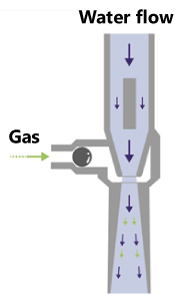
Attached directly to a water faucet, the flow of tap water causes a drop in pressure near the nozzle—where the flow path narrows—causing air to be drawn in through the suction port.
*According to Bernoulli’s principle, pressure decreases where the flow velocity is high.
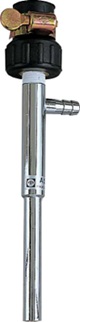
Advantages and disadvantages of faucet-mounted water aspirators
Metal aspirator (Model AS-2)
| Advantages | Disadvantages |
| A vacuum environment can be easily obtained as long as a water supply is available. | Ultimate vacuum cannot exceed the vapor pressure of water. |
| Highly Affordable: Extremely low-cost. | Requires a continuous flow of tap water during operation. |
| — | Aspirated solvents are discharged directly into the drainage system. |
| Water temperature | 15℃ | 30℃ | |
| Ultimate vacuum | hPa | 14.6 | 39.9 |
| Torr | 11 | 30 | |
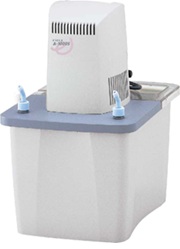
Advantages and disadvantages of pressurized circulating aspirator
Aspirator (Model A-1000S)
| Advantages | Disadvantages |
| Can be used even in locations without a water supply or where water pressure is low. | Ultimate vacuum cannot exceed the vapor pressure of water. As the water temperature rises due to motor heat or other factors, the vacuum performance degrades. |
| Closed Structure: The design ensures that aspirated solvents and other substances are not discharged directly into the drainage system. | Aspirated solvents accumulate within the tank, requiring proper drainage and disposal. The presence of accumulated solvents will also cause the vacuum level to deteriorate. |
| Water temperature | 5℃ | 10℃ | 20℃ | 30℃ | |
| Ultimate vacuum | hPa | 9.2 | 12.9 | 23.7 | 41.8 |
| Torr | 6.9 | 9.7 | 17.8 | 31.4 | |
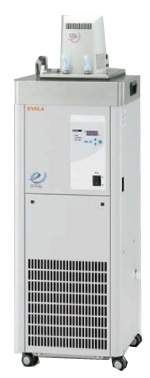
Advantages and disadvantages of low temperature circulator with aspirator
(Model CA-1116US)
| Advantages | Disadvantages |
| This system allows for the simultaneous external supply of cooling water and pressure reduction. | Compared to the pressurized circulating aspirator A-1000S, the price is higher. |
| Stable cooling of the aspirator chamber ensures a high ultimate vacuum level. | — |
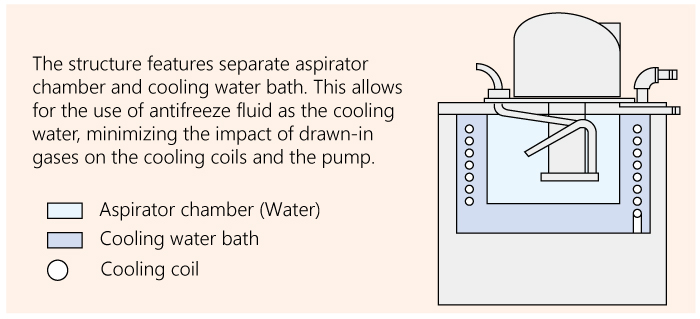
| The aspirator chamber and cooling water bath are separate and independent (see the schematic of the double-chamber structure below); therefore, even if the water contains organic solvents through suction, the water in the aspirator chamber can be treated as waste liquid. | — |
Double-chamber structure
| Water temperature | 5 | 10 | 20℃ | 30℃ | |
| Ultimate vacuum | hPa | 9.2 | 12.9 | 14.6 | 39.9 |
| Torr | 6.9 | 9.7 | 17.8 | 31.4 | |