Product line-up
HOME > Product line-up > Vacuum Pumps > What is a vacuum pump? > What is a vacuum pump?

TOKYO RIKAKIKAI CO., LTD.
HOME > Product line-up > Vacuum Pumps > What is a vacuum pump? > What is a vacuum pump?
The Reality of Vacuum: It is never “Zero”
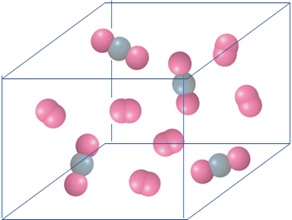
Currently, it is physically impossible to create an “absolute vacuum” where nothing exists, regardless of the technology used. Even in the highest vacuum levels achievable by human engineering, millions of gas molecules remain in a 1L vessel. In fact, it is believed that there is no space in the universe that is truly “empty.”
The International System of Units (SI) for pressure is the Pascal (Pa). Other commonly used units include mmHg (millimeters of mercury), Torr, atm (standard atmosphere), and bar. The conversion rates are as follows:
1 Pa = 7.501×10⁻³mmHg = 7.501×10⁻³Torr = 9.869×10⁻⁶atm = 1×10⁻⁵bar
Historically, “mbar” (millibar) was used in weather forecasting to measure atmospheric pressure for systems like low-pressure areas and typhoons. Following the 1992 amendment of the Measurement Act, “mbar” was replaced by “hPa” (hectopascal). Since 1 mbar = 1hPa, the numerical values remain the same despite the change in unit designation.
Rotary Evaporator
This is the most common device used to remove solvents and moisture through distillation.
Freeze Dryer (Lyophilizer)
This device removes moisture from a product by freezing it and then sublimating the ice into vapor. In recent years, it has been utilized in a wide range of fields, with various specialized systems being developed, such as spray freeze-drying granulation systems.
[Point 1] What level of ultimate pressure (vacuum level) is required?
The required pressure (vacuum level) varies depending on the application.
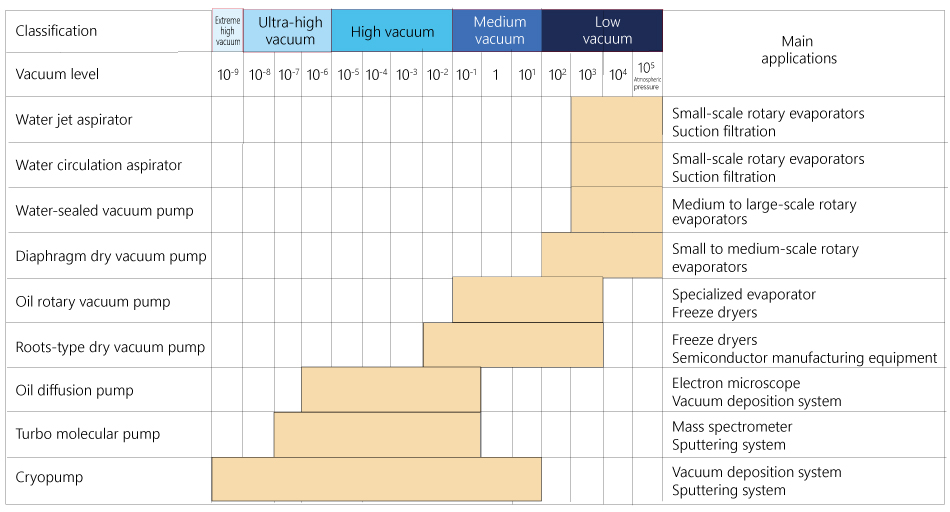
Referring to the “Equipment Types, Pump Categories, and Vacuum Ranges” chart above, identify which type of vacuum pump is suitable for your specific needs.
[Point 2] Which type is better: “Oil” or “Dry”?
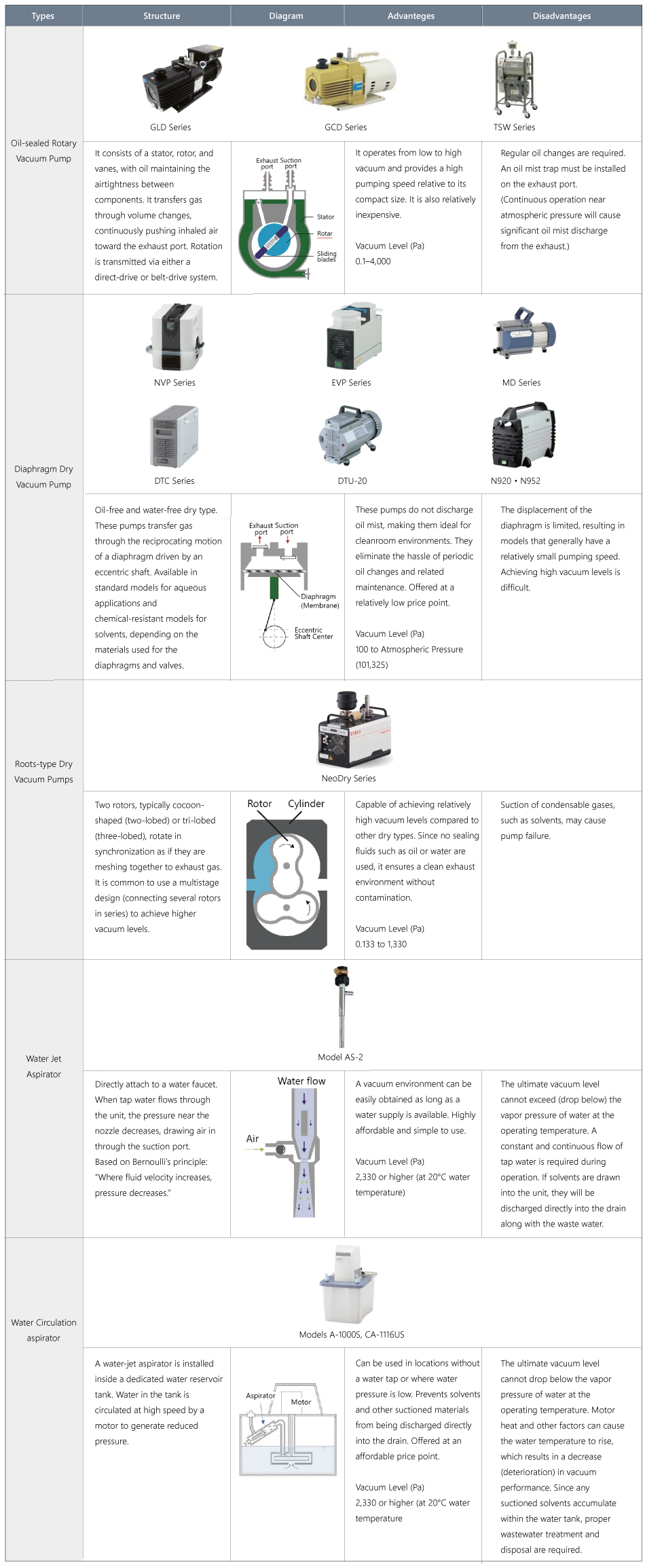
Oil Pumps: If high vacuum levels are your priority and you are not concerned about oil maintenance, oil pumps are the preferred choice for achieving a high vacuum.
Dry Pumps: If you must avoid oil mist and require a clean environment, a dry pump is essential for maintaining a contaminant-free atmosphere.
[Point 3] How long will the evacuation take?
The required pumping speed is calculated based on the volume of the vessel to be evacuated and the desired evacuation time.
[Point 4] What type of gas (solvent) will be evacuated?
Vacuum pumps are available in different material specifications, such as Standard (aqueous/water-based) or Chemical-resistant (corrosion-resistant).
It is essential to verify the compatibility of the pump specifications based on the type of gas and the corrosiveness of the substances being evacuated.
Additional selection criteria include price, installation space, and power requirements.
Pressure Ranges by Pump Type (Non-Exponential Notation)
To help you choose the right pump, here is a comparison of typical pressure ranges using standard numerical values (Pa).

This movable rack significantly reduces the burden of oil change
| Model | OPM-1000 |
| Cat. No. | 278230 |
| Compatible pump size | Base dimensions: Width 120 to 170mm, Depth: 200 to 300mm, Height: 18mm |
| Compatible pump weight | Max. 31kg |
| Tilt angle of pump | Approx. 30° angle |
| To move a pump | By casters |
| Outer dimensions (mm) | 246W x 533D x 361H (including handle) |
| Weight | Approx. 7kg |