Product line-up
HOME > Product line-up > Shakers > What is a shaker? > What is a Shaker?

TOKYO RIKAKIKAI CO., LTD.
HOME > Product line-up > Shakers > What is a shaker? > What is a Shaker?
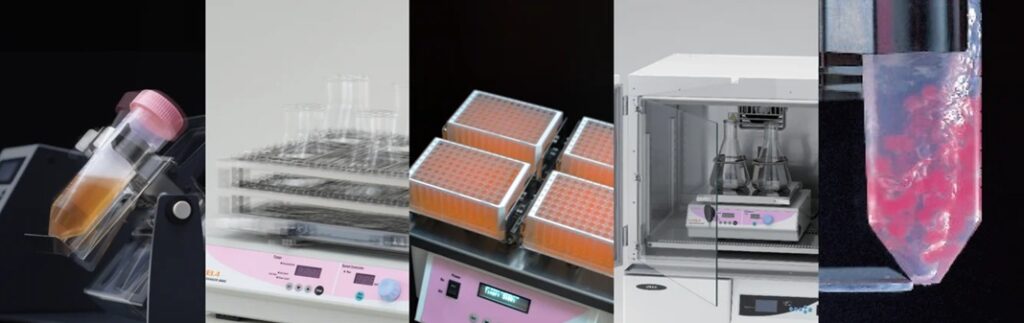
It is used to shake vessels such as test tubes and flasks horizontally or vertically to mix or react substances within samples. It is also used for culturing microorganisms as well as plant and animal cells. It is utilized across various fields and applications.

The primary fields and applications of shakers include the following:
| Fields | Applications and Examples | |
| Organic Chemistry Inorganic Chemistry | Mixing, Dissolution, Extraction, Reaction | ・Mixing solvents and solutions ・Preparation and dissolution of reagents ・Various reaction tests in water quality analysis ・Extraction and leaching of hazardous substances in soil and industrial waste |
| Biochemistry Medicine Pharmaceuticals Molecular Biology Analysis | Extraction, Separation, Reaction, Genetic Engineering, Washing | ・Staining and destaining of electrophoresis gels ・DNA/RNA extraction ・Enzymatic and antibody reactions ・Washing membrane filters ・Hybridization ・Pre-treatment and extraction for residual pesticides and allergen testing |
| Biology Agriculture | Culture | ・Culturing of microorganisms (E. coli, actinomycetes, molds, etc.) ・Culturing of plant and animal cells |
There are various shaking methods depending on the purpose and application.
The primary methods are as follows:
| Shaking methods | Description | Illustration | Lineup (Shaking method) |
| Reciprocal shaking (Horizontal shaking) | This is the most common shaking method, utilizing a side-to-side reciprocating motion. It is suitable for a wide range of applications such as reactions, dissolutions, and culturing. Thanks to its excellent aeration performance, it is also ideal for pre-culturing yeast and for culturing stressed E. coli cells after transformation. | 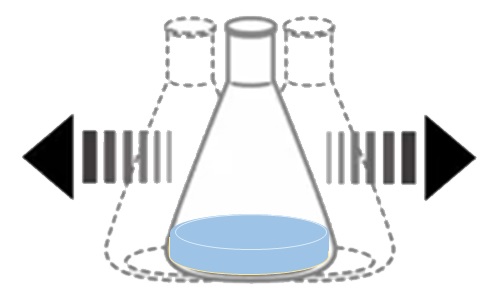 | MMS-1020(Reciprocal) MMS-120H(Reciprocal+High-humidity) MMS-3021(Reciprocal※) ※For testing of food allergens and residual pesticides MMS-3020(Reciprocal/Orbital) MMS-320(Reciprocal/Orbital) MMS-4020(Reciprocal/Orbital/Figure-8) MMI-1000A・B(Reciprocal/Orbital) MRM-1000(Vertical rotation/reciprocal /Reciprocal+vibration) NTS-4000(Reciprocal) |
| Orbital shaking (Rotary shaking) | This shaking method follows a circular motion. Compared to reciprocating shaking, it is said to impose less physical stress on samples, making it suitable for a wide range of applications such as reactions, dissolutions, and culturing. It is particularly used in culturing experiments for plants and microorganisms, as well as for DNA extraction and protein production. | — | MMS-220H(Orbital+High-humidity) MMS-3020(Reciprocal/Orbital) MMS-320(Reciprocal/Orbital) MMS-4020(Reciprocal/Orbital/Figure-8) MMS-520(Orbital+Powerful shaking) MMS-5020(Orbital+Powerful shaking) MRM-1000(Vertical rotation/reciprocal/Reciprocal+vibration) CM-1000(Orbital+High-speed) |
| Figure-8 shaking | This model utilizes a combination of reciprocating and orbital shaking motions, offering superior mixing and agitation efficiency. It enables uniform and effective shaking, making it ideal for dissolution, stirring, and mixing in chemistry-related fields. It is also well-suited for molecular biology applications such as gel and membrane washing, ELISA reactions, and Western blotting procedures. | — | MMS-420(Figure-8) MMS-4020(Reciprocal/Orbital/Figure-8) |
| Vertical shaking | This type of shaker moves the samples vertically up and down. It offers the highest efficiency for mixing and agitation, making it ideal for liquid-liquid extraction and the blending of powders. It is widely used in sample pretreatment processes such as extracting food, soil, and environmental contaminants using separatory funnels. |  | MMV-1000W(Vertical/Inclined) |
| Single-axis shaking | This shaking method involves vertical arc motion and is suitable for L-shaped test tubes and vials. The high contact efficiency between liquid and air makes it ideal for microbial cultivation and BOD (Biochemical Oxygen Demand) testing. | — | — |
| Seesaw-type shaking | This shaking method gently rocks the platform up and down like a seesaw, providing uniform and mild agitation. It is commonly used in temperature-controlled equipment such as hybridization ovens for DNA/RNA hybridization. Typical applications include placing hybridization bags or plastic containers for gel staining and destaining on the platform. | — | — |
 Comparison of the three shaking modes in the MMS series shaker
Introduction to the plate mixer model MMP-1000: For high-speed shaking
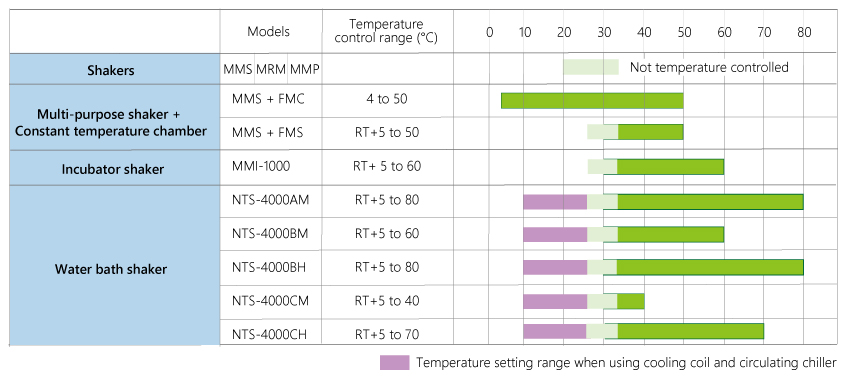
The temperature control range of each shaker is as follows.
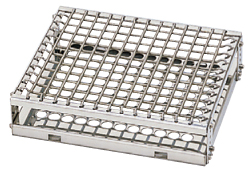
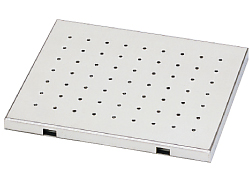
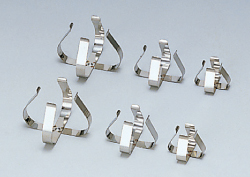
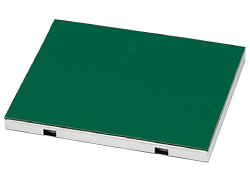
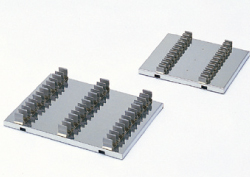
Optional shaking platforms and holders should be selected based on the vessels used, the number of samples, and the specific application.
Incubator shakers are commonly used in research and culture settings. While the name is familiar, there may be few opportunities to reconsider the specific role this equipment plays.
A incubator shaker is a device capable of shaking vessels while maintaining a constant temperature. Its key feature is the ability to perform “temperature management” and “mixing/culture” simultaneously.
For example, in “microbial and cell culture”:
Experiments involving the culture of organisms such as E. coli, yeast, animal cells, and plant cells require a constant temperature while ensuring a uniform distribution of air and nutrients. A incubator shaker, which can stably create such an environment, is an indispensable asset for culture experiments.
EYELA offers both types of shakers; one with a separate constant temperature chamber and an integrated constant temperature shaker. There are advantages to having a fully integrated system, as well as distinct benefits to the traditional separate configuration. Below are the detailed merits of both the integrated and separate models.
| Product | Incubator shaker (Integrated) | Shaker + Constant Temperature Chamber (Separated) | |
| Shaker | Constant Temperature Chamber | ||
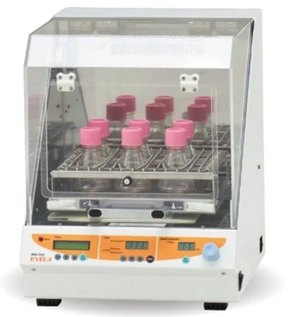 | 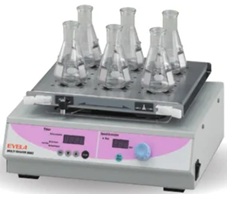 | 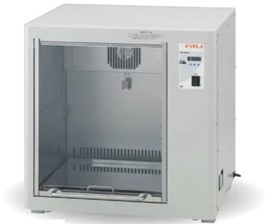 | |
| Model | MMI-1000A | MMS-320 | FMS-100 |
| Cat. No. | 281790 | 267830 | 191060 |
| Shaking method | Reciprocal/Orbital | Reciprocal/Orbital | — |
| Shaking speed | 20 to 250rpm | 20 to 250rpm | — |
| Amplitude | 25mm | 25mm | — |
| Temperature control range | RT + 5 to 60℃ | — | RT + 5 to 50℃ |
| Temperature control accuracy | Within ±0.5°C | — | ±0.2°C |
When using the universal shaking platform with spring, MMA-1000A can accommodate up to two 1L Erlenmeyer flasks. The reciprocal and orbital shaking modes can be easily toggled with a single lever.
MMS-320 shaker supports both reciprocal and orbital shaking. Shaking modes can be easily switched with a single-touch operation using the front lever. FMS-100 constant temperature chamber can accommodate shakers with dimensions up to 400W × 340D mm. When installed, the shaker can be used with Erlenmeyer flasks up to 2L in size.
High-Speed Plate Mixer, Model MMP-1000
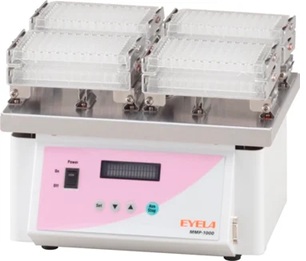
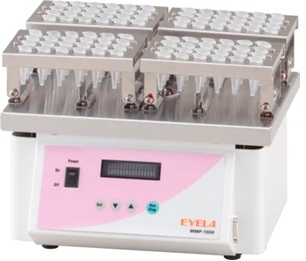
Configuration Example:
MMP-1000 + 8 Microplates (2 plates/rack)
Configuration Example:
MMP-1000 + 96 Microtubes (24 Microtubes/rack)
*Optional shaking racks are sold separately. Vessels are not included.
By simply changing the shaking racks, the unit supports shaking for microtubes, microplates, and deep-well plates. The shaking racks feature a one-touch attachment/detachment mechanism for easy replacement.
| Product | 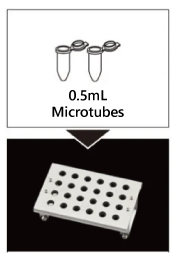 | 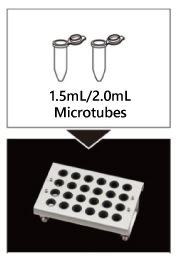 | 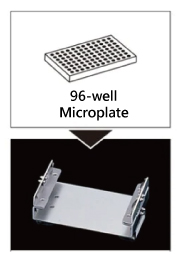 | 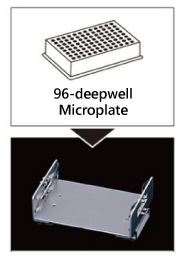 |
| Model | MP-R0.5 | MP-R1.5 | CM-RP | CM-RD |
| Cat. No. | 286230 | 286240 | 188190 | 192310 |
| Rack type | Microtube rack 0.5mL | Microtube rack 1.5/2.0mL | Microplate rack (stackable up to 2 units) | Deepwell microplate rack |
| Max. number of vessels | 24 pcs/rack | 24 pcs/rack | 2 plates/rack | 1 plate/rack |
| Max. number of racks | 4 pcs | 4 pcs | 8 pcs | 4 pcs |
| Applications | ・Preparation of buffers, reagents, and enzyme solutions ・Cell suspension and lysis buffer mixing ・Enzymatic reactions for DNA/RNA extraction, etc. | ・Acceleration of antigen-antibody reactions (e.g., ELISA) ・Biopanning of phage display libraries ・Low volume high-throughput culture of E. coli and yeast, etc. | ||
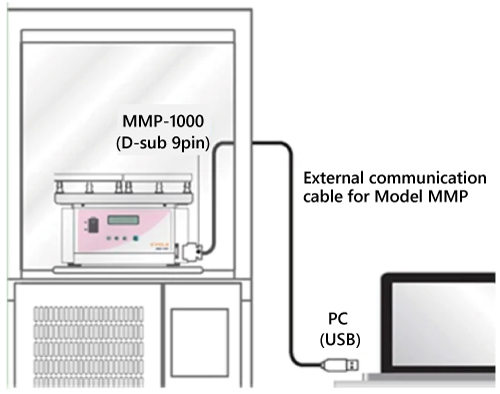
With an operating ambient temperature range of 4 to 50°C, this unit can be used inside FMC/FMS series shaker chambers or LTE series incubators. It is suitable for applications such as accelerating enzymatic reactions in plates or performing shaking cultures.
By using the optional communication cable and dedicated software, you can control the start/stop functions, shaking speed, and timer settings from a PC while the unit is installed inside the chamber.
*The dedicated software can be downloaded from our website.