Product line-up
HOME > Product line-up > Constant Temperature Circulators > What is a Chiller? > What is a Chiller?

TOKYO RIKAKIKAI CO., LTD.
HOME > Product line-up > Constant Temperature Circulators > What is a Chiller? > What is a Chiller?
A “chiller” is a general term for a device that circulates water (or a low-temperature heat transfer fluid) to cool, heat, or control the temperature of a target sample or equipment.
Because they are primarily used for cooling, they are commonly referred to as “Chillers” (from the word “chill”).
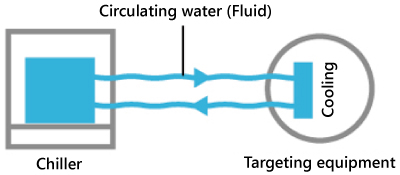
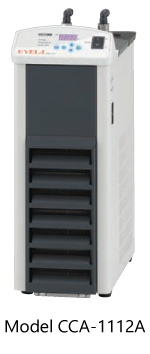
Enables consistent and uniform temperature control under identical conditions throughout the year.
In industrial equipment, analytical instruments, and food processing machinery, precise temperature control is essential for consistent product and process management. Relying on tap water or cooling towers carries the risk of performance and quality fluctuations between the summer and winter seasons.
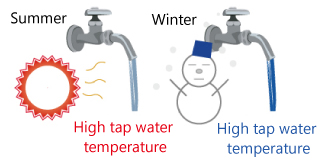
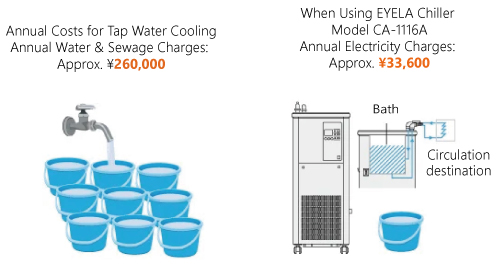
Significant cost savings can be achieved as compared to the tap water cooling method.
Cost Comparison: Tap Water vs. EYELA Chiller (Model CA-1116A)
A chiller features a closed-loop design that recirculates the cooling water from its internal bath, eliminating the continuous waste associated with tap-water systems. Below is a comparison between using tap water and the EYELA Chiller Model CA-1116A (Power consumption: Approx. 900Wh at 100VAC, 50Hz, 100% load).
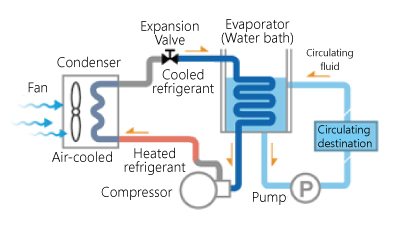
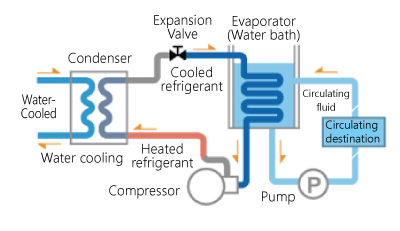
A chiller absorbs heat from a target sample or equipment (or a specific component) to provide cooling. The chiller itself must then discharge the absorbed heat. The refrigeration system of a chiller offers two types of heat dissipation methods: Air-cooled and Water-cooled, allowing you to select the model best suited for your environment.
Air-Cooled Refrigeration System
Water-Cooled Refrigeration System
The unit features an internal fan motor, making it exceptionally easy to install. Because this system discharges heat directly into the surroundings, heat can accumulate in confined or poorly ventilated spaces. This buildup of heat may negatively impact the cooling capacity and service life of the chiller. Therefore, an exhaust system or proper ventilation may be required.
This system requires condenser cooling water to operate. It offers superior cooling efficiency and does not release exhaust heat into the room. Furthermore, it ensures highly stable cooling capacity regardless of the ambient temperature.
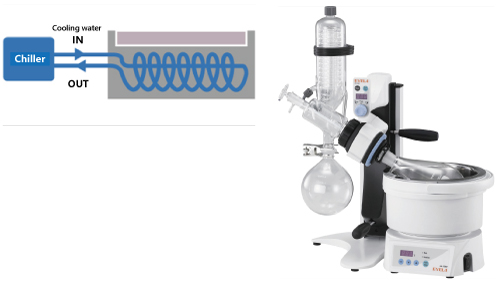
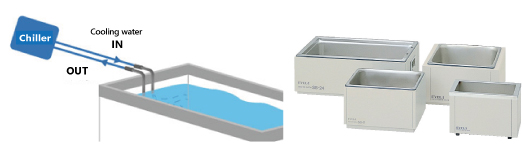
There are also two types of circulation systems: Open-loop and Closed-loop. The internal structure of the chiller differs depending on where the temperature-controlled fluid is circulated.
Closed-Loop Circulation System
Open-Loop Circulation System
A closed-loop system is designed for cooling targets that have an internal, sealed heat exchanger. In this setup, the cooling fluid circulates through a dedicated flow path without being exposed to the atmosphere.
Ex.) Rotary evaporators, etc.
An open-loop system is designed for cooling targets where the fluid surface is exposed to the atmosphere, such as an open-top tank or a bath.
Ex.) Bath-type vessels like water baths
EYELA offers a diverse lineup of cooling water chillers (recirculating chillers) and heating water circulators, available in both air-cooled and water-cooled types. Our extensive range includes models for low-temperature, low-to-high temperature, and high-to-low temperature applications to meet your specific needs. Please select the optimal model by considering key factors such as temperature range, stability, and cooling capacity.
View EYELA Chiller Catalog: Features and Specifications List
| Point 1: Circulation temperature and accuracy | What is the circulation (set) temperature? / What is the temperature accuracy in ±°C? |
| Point 2: Cooling capacity | What is the heat load or required cooling capacity? (In W?) |
| Point 3: Circulation method | Closed-loop or open-loop circulation? (What is the circulation destination?) |
| Point 4: Circulation capacity | What is the required flow rate in L/min? Additionally, what is the required discharge pressure (lifting height in m) in MPa? |
| Point 5: Type of circulating fluid | What type of circulating fluid will be used? |
| Point 6: Environmental friendliness | Is the refrigerator a non-fluorocarbon or low-GWP type with low environmental impact? Is it energy-saving? |
| Point 7: Securing installation space | Is the product sized to fit in the installation location? |
Note: Other items such as air-cooled/water-cooled, piping, and power supply must also be checked.
We also offer models equipped with a wide variety of features beyond these basic points.
| Circulating fluid compatibility | Circulation of pure water and silicone oil-based brine. | High-pressure pump | High lifting height with a maximum of 20m or more. |
| Safety features | Detection of temperature abnormalities, refrigerator overload, abnormal water levels, abnormal pressure, and abnormal flow rates. | Alarm functions | Outputs various abnormalities mentioned left as alarms; stops the equipment or activates warning lights depending on the situation. |
| Remote operation | Chiller start-stop, circulation pump ON-OFF, and remote control upon abnormality detection. | Continuous operation | Long-term operation, such as 24-hour full-load operation. |
| High-precision temperature control | High-precision temperature control from approximately ±0.1°C to ±1°C. | Communication | Linked operation with rotary evaporators via communication. |
| Recorder output | Output terminal for recorders. |
EYELA uses refrigerants with low environmental impact for its water chillers and promotes the transition to non-fluorocarbon and low-GWP (Global Warming Potential) alternatives. Additionally, we implement initiatives to minimize environmental impact, such as refrigerant recovery services.
Non-fluorocarbon refrigerant products significantly contribute to global warming countermeasures. Unlike conventional fluorocarbon-based products, they have an Ozone Depletion Potential (ODP) of 0 and an extremely low Global Warming Potential (GWP). Since they are exempt from the mandatory simplified inspections for equipment with refrigeration units under the Act on Rational Use and Proper Management of Fluorocarbons, they require no management tasks and eliminate the cost and effort typically required for disposal.

We are working to transition products that traditionally used fluorocarbon refrigerants with a high GWP of 2,500 or more to low-GWP refrigerants (GWP less than 2,500).
| Q: | I have a question about chillers. |
| A: | Please click here for Frequently Asked Questions (FAQ). |
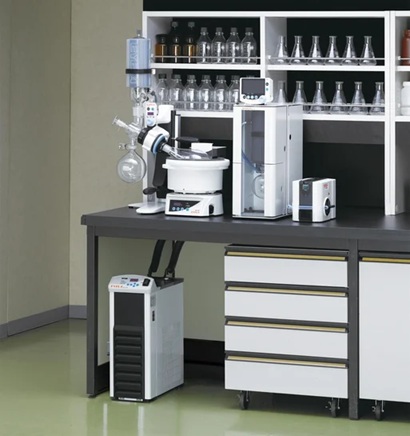
| Product | Model | QTY | Cat. No. |
| Rotary evaporator | N-1300V-WS | 1 | 275340 |
| Low temperature circulator | CCA-1112A | 1 | 268450 |
| Inverter diaphragm vacuum pump | NVP-1000 | 1 | 261800 |
| Solvent recovery unit | DPE-1150 | 1 | 271180 |
| NVC communication cord (1m) | COM-1M | 3 | 269460 |
| NVC communication cord (2m) | COM-2M | 1 | 269470 |
| Branch box for NVC communication | F-BOX | 1 | 269620 |
| Anti-condensation cover | — | 1 | 270740 |
| Cooling hose set 2m 9mm ID | — | 3 | 112700 |
| Vacuum hose 6 ID x 15mm OD | — | 1 | 119170 |
| Anti-condensation nozzle cover | — | 1 | 282130 |
Total System Power Capacity: 20.6 A
Required Number of Outlets: 3
Please see here for more examples of chillers used in standard evaporation systems.