User’s Voice_Tokyo Univ. of Science
HOME > User’s Voice_Tokyo Univ. of Science

TOKYO RIKAKIKAI CO., LTD.
HOME > User’s Voice_Tokyo Univ. of Science
Tokyo University of Science
Department of Pharmacy, Faculty of Pharmaceutical Sciences,
Laboratory of Pharmacognosy
Professor Noriyasu Hadano
Exploring the Scientific Basis of Nature-Derived Medicines
With a mission to scientifically evaluate the efficacy of natural substances, our research is driven by the following four core perspectives:
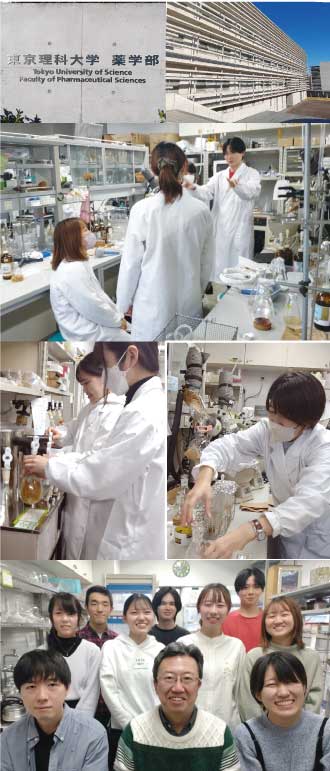
To support these diverse research initiatives, we rely on high-performance EYELA equipment, including eight rotary evaporators, two freeze dryers (FD-1 and FDU-1110), a constant temperature bath with magnetic stirrer (PSL-1400), and a centrifugal evaporator (CVE-3110) paired with a cold trap (UT-1000).
The primary reason we choose EYELA is the familiarity and trust built since my student days. Beyond the ease of use, I am deeply grateful for their exceptional support—whether it is providing attentive maintenance for equipment over 30 years old or customizing new units for immediate, seamless integration into our specific workflows upon delivery.
Every piece of equipment continues to evolve, and I truly appreciate the designs tailored to university research environments—particularly the lighter and more streamlined profiles. Looking ahead, one area for potential improvement would be anti-condensation measures for rotary evaporators. I look forward to seeing future advancements in this specific functionality.