User’s Voice_Yokohama Univ.
HOME > User’s Voice_Yokohama Univ.

TOKYO RIKAKIKAI CO., LTD.
HOME > User’s Voice_Yokohama Univ.
Yokohama University of Pharmacy
Department of Pharmaceutical Science
Laboratory of Natural Organic Chemistry
Professor Mitsuru Shoji
Synthesis of Rare Bioactive Compounds and Innovation in Light-Driven Chemical Reactions
Nature is a rich source of compounds with remarkable biological activities, such as anti-cancer properties, found in fungi, plants, and marine sponges. While these compounds are invaluable to humanity, obtaining them in sufficient quantities is often challenging due to their scarcity in nature or the genetic mutation of producing organisms. Our laboratory aims to contribute to medical advancement by achieving the total chemical synthesis of these rare natural products.
For example, Cotylenol A, isolated from filamentous fungi, exhibits fascinating anti-cancer activity. However, its supply through cultivation has become extremely difficult due to mutations in the producing strain. To address this, we are challenging ourselves to establish a stable supply through chemical synthesis and develop efficient methods for creating its derivatives.
Furthermore, the synthesis of complex molecular structures typically requires numerous steps. To streamline this, we are developing innovative one-pot reactions that achieve multiple transformations in a single step. From an environmental perspective, we incorporate biocatalysis (enzymes) and light-energy-driven reactions to ensure sustainable production.
To provide the essential compounds humanity needs, it is vital to develop methods that can synthesize newly discovered bioactive substances and supply improved derivatives. We are dedicated to collaborating with diverse researchers to ensure a robust supply of these significant chemical entities.
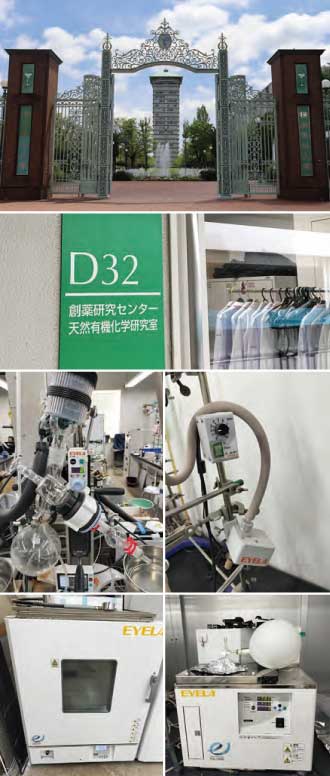
Our laboratory has been a loyal user of EYELA products since our very beginning.
In the field of synthetic organic chemistry, low-temperature constant temperature baths and rotary evaporators are essential tools. Because EYELA products offer both high performance and a comprehensive support system, they are always our first choice when selecting new equipment.
We utilize rotary evaporators for solvent removal and product concentration, tailored to the specific requirements of each experiment. In addition to standard rotary evaporators, we leverage the unique advantages of various configurations—such as connecting small-scale evaporators to vacuum lines or integrating vacuum control units with small distillation apparatuses—to optimize our research processes.