Product line-up
HOME > Product line-up > Incubators > What is an Incubator? > What is an Incubator?

TOKYO RIKAKIKAI CO., LTD.
HOME > Product line-up > Incubators > What is an Incubator? > What is an Incubator?
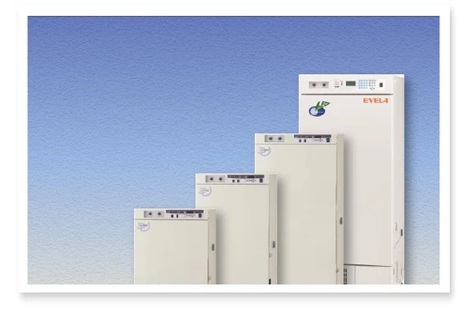
Used for various purposes such as constant temperature testing, reliability testing, microbial culture, plant growth, and long-term sample storage. Some models also control humidity, lighting conditions, and CO2 concentrations in addition to temperature.
Incubators are broadly classified into the following four types.
Note: Diagrams are schematic; actual structures and layouts vary by model.
| Types | Control methods |
| 1. Incubator | Heater |
| 2. Low temperature incubator | Heater + Refrigeration unit |
| 3. Environmental chamber | Heater + Refrigeration unit + Humidifier |
| 4. Illuminated incubator | Heater + Refrigeration unit + Humidifier + Lighting |
Since temperature is controlled using only a heater, use is limited to ambient temperature +5°C or higher. Models include a type that directly circulates conditioned air within the chamber (Forced convection) and a type that circulates air within an air jacket inside the walls (Air jacket natural convection).
1-1. Forced convection
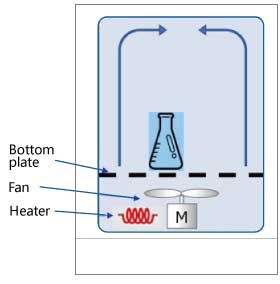
Direct circulation of conditioned air within the chamber
[Pros] Rapidly reaches set temperature. Excellent temperature distribution.
[Cons] Airflow hits samples directly, causing culture media and other contents to dry out easily.
Note: EYELA product lineup does not include forced convection types as “incubators.” These are sold as forced air flow ovens; however, as they are primarily used at temperatures exceeding 100°C, they are unsuitable for microbial culture, plant growth, or long-term sample storage.
1-2. Air jacket natural convection
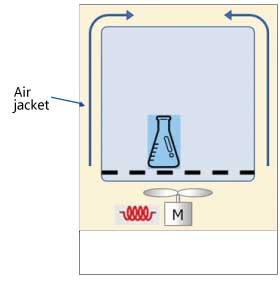
Circulation of conditioned air within the air jacket inside the walls
[Pros] Airflow does not hit samples directly, preventing culture media and other contents from drying out.
[Cons] Takes time for temperature to stabilize. Temperature distribution is less uniform.
<SLI Series · FMS Series>
Equipped with both a heater and a refrigeration unit, this type allows for temperature control at or below ambient levels. This model is necessary for applications near room temperature (20 to 25°C). Similar to standard incubators, both forced convection and air jacket types are available. It can also be used for storing samples below room temperature.
2-1. Forced convection
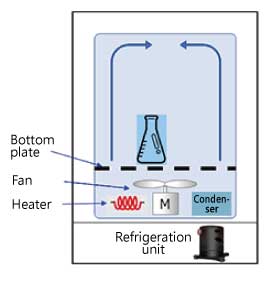
Direct circulation of conditioned air within the chamber
[Pros] Rapidly reaches set temperature. Excellent temperature distribution.
[Cons] Airflow hits samples directly, causing culture media and other contents to dry out easily.
<LTE Series · FMC Series>
2-2. Air jacket natural convection
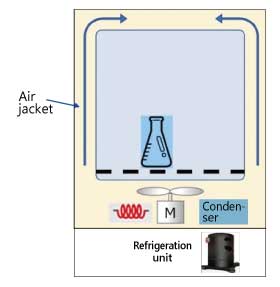
Circulation of conditioned air within the air jacket inside the walls
[Pros] Airflow does not hit samples directly, making culture media and other contents less prone to drying out.
[Cons] Takes time for temperature to stabilize. Temperature distribution is less uniform.
<LTI-E Series>
Forced convection
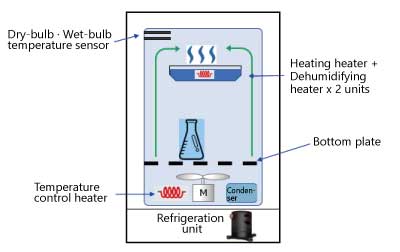
Temperature and humidity can be controlled using programmed gradients. Ideal for environmental testing, storage testing, and reliability testing.
Temperature is regulated by a heater and cooling unit. Conditioned air is circulated through the chamber by a fan. Humidity is measured by dry-bulb and wet-bulb temperature sensors and regulated by a humidifier and the dehumidifying action of the cooling unit.
Forced convection (Downflow system)
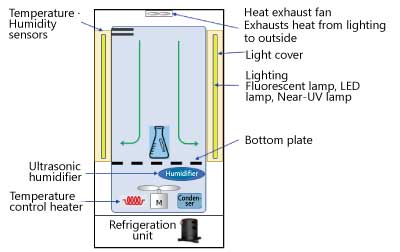
Temperature, humidity, and lighting conditions can be precisely programmed and controlled. Depending on the application, fluorescent lamps, daylight lamps, or LED lamps can be installed as the light source. Ideal for plant growth.
Temperature is regulated by a heater and a cooling unit. Conditioned air is circulated through the chamber by a fan.
Humidity is measured by a sensor and regulated by an ultrasonic humidifier and the dehumidifying action of the cooling unit.
Lighting is installed on the outside of the chamber, with light passing through the glass to irradiate the interior.
| Purpose | Content | Operating temperature | Incubators used |
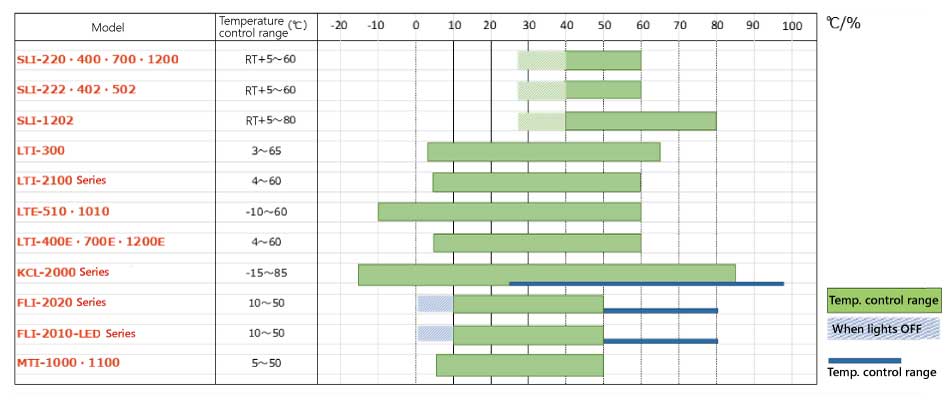
| Constant Temperature Testing | Suitable for heat resistance testing, durability testing, environmental testing, and reliability testing under constant temperature or programmed temperature profiles | -5 to 80℃ | Incubator, Low temperature incubator, Environmental chamber |
| Constant Temperature and Humidity Testing | Environmental testing, storage testing, and reliability testing for materials, pharmaceuticals, and food products under specific temperature and humidity conditions | 20 to 85℃ | Constant temperature incubator, Environmental chamber |
| Photo-Irradiation Testing | Degradation testing of raw materials, chemical products, food, and cosmetics under temperature, humidity, and light conditions. Lightfastness and environmental testing using visible and ultraviolet light | 5 to 60℃ | Photo-irradiation incubator, Photostability incubator |
| Microbial/Bacterial Culture and Plant Growth | Culture of various microorganisms and bacteria; plant growth and cultivation | 4 to 65℃ | Incubator, Low temperature incubator, Illuminated incubator |
| Animal Cell Culture | Culture of mammalian cells, such as human cells (Regulates temperature, humidity, and CO2 concentration to establish conditions mimicking the internal environment of the body) | 35 to 42℃ | CO2 incubator |
| Sample Storage | Long-term storage of samples and low-temperature storage after culture | -10 to 20℃ | Low temperature incubator, Constant temperature incubator |
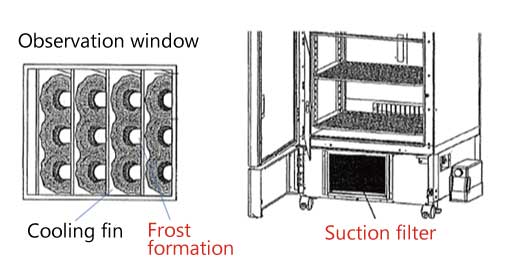
Continuous operation under low-temperature ranges (especially below 10°C) or high-humidity conditions may cause moisture inside or around the chamber to frost on the cooling unit. This frost buildup can lead to temperature control failure, reduced refrigeration performance, or equipment malfunction.
Please monitor the frost accumulation on the cooling fins through the observation window and periodically remove it using the unit’s defrost function. Additionally, a clogged suction filter can cause a drop in cooling performance or equipment failure. Please clean the filter regularly.
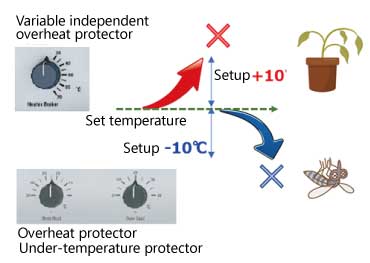
Depending on the model, constant temperature chambers are equipped with a “Variable Independent Overheat Protector” and a “Variable Independent Under-temperature Protector.” While the unit’s temperature control board includes safety features such as “temperature upper/lower limit alarms” and alarm display functions, a failure of these board-level protections or a malfunction of the board itself could lead to a temperature runaway, potentially causing overheating or damage to biological samples. By providing overheat and under-temperature protectors separate from the temperature control board, temperature runaway can be prevented. These are typically set with a margin of approximately 10°C relative to the operating temperature.
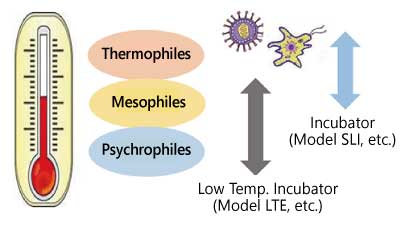
Microorganisms and bacteria have optimal temperatures for growth and proliferation depending on their species. They are generally categorized into the following three groups:
Many food poisoning bacteria can proliferate even at refrigerator temperatures. Additionally, wine yeasts prefer relatively low temperatures; the optimal range is 20 to 25°C for red wine and 15 to 20°C for white wine. For these cultivation and fermentation experiments, low temperature incubators equipped with a refrigeration system (such as Model LTE series) are required. Conversely, since many foodborne pathogens like Salmonella and E. coli have growth temperatures between 30 to 40°C, incubators such as Model SLI series are used.

In plant growth testing, operating temperatures vary depending on the objective. Standard growth experiments are typically conducted between 10 to 35°C, simulating natural environmental conditions. However, cold resistance or disease susceptibility tests may require low temperatures around 5 to 10°C, while stress tolerance tests can reach high-temperature conditions of 40 to 45°C.
Additionally, for experiments that cycle between day and night temperatures over a 24-hour period, or for germination tests where temperature fluctuations promote sprouting, incubators with programmable temperature settings are utilized.
The light sources (fluorescent lamps and LED lamps) are not compatible.
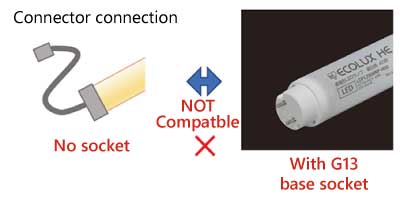
The straight-tube LED lamps used in the new FLI-2020 model are a “socketless” type. Since the FLI-2010 and 2010-LED models utilize the “G13 base socket” standard, they are not compatible. Therefore, conventional fluorescent lamps or the straight-tube LED lamps from the FLI-2010-LED series cannot be installed in the new FLI-2020 series.
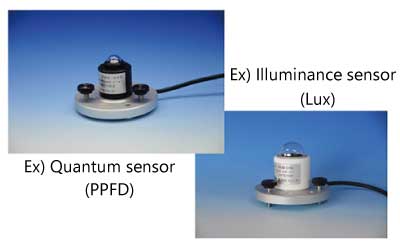
At first glance, the relationship between illuminance (Lx) and photosynthetic photon flux density (μmol⋅m−2⋅s−1) may appear to be directly proportional, as the PPFD value increases alongside the lux value. However, simple conversion is not possible.
This is because illuminance (Lx) is based on human visual sensitivity, whereas PPFD measures the number of photons within the specific wavelength range (400 to 700nm) that plants use for photosynthesis. The conversion ratio fluctuates significantly depending on the spectral distribution of the light source.
20 μmol・m⁻²・s⁻¹ ≈ 1,400 Lx
50 μmol・m⁻²・s⁻¹ ≈ 4,000 Lx
100 μmol・m⁻²・s⁻¹ ≈ 7,000 Lx
150 μmol・m⁻²・s⁻¹ ≈ 12,000 Lx
270 μmol・m⁻²・s⁻¹ ≈ 19,000 Lx
| Q : | Do you have any questions about incubators? |
| A : | Please click here for FAQ. |