Product line-up
HOME > Product line-up > Organic Synthesizers > Examples of Reactor Setups > Examples of Reactor Setups

TOKYO RIKAKIKAI CO., LTD.
HOME > Product line-up > Organic Synthesizers > Examples of Reactor Setups > Examples of Reactor Setups
▶ Ensures reliable condensation of reaction solvent vapor for efficient reflux
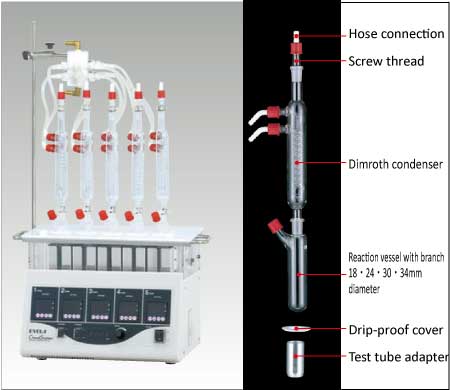
The system allows for heating, cooling, stirring, and reflux experiments. Suitable for heating reactions beyond the boiling point. Efficient reflux experiments can be conducted using the Dimroth condenser. This system ensures reliable water-based reflux experiments for polymerization reactions and green chemistry applications. It supports synthesis scales from 10 to 30mL with a temperature control range of -10 to 160℃ (with 5 individual temperature controls).
▶ For Anhydrous and Oxygen-Free Reactions
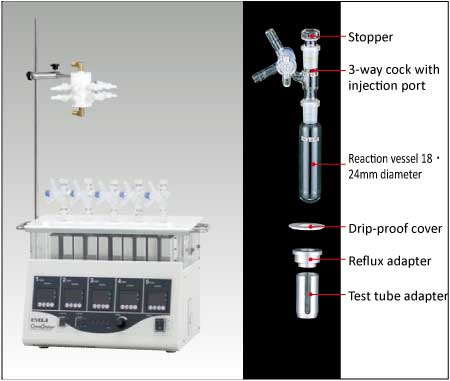
It is suitable for reactions that require gas replacement and reactions of compounds that are unstable due to trace amounts of oxygen or water. It can be used as a Schlenk tube by applying vacuum grease to the joint. (*The cock is not a Schlenk cock.) The synthesis scale from 7 to 12.5mL, temperature control range -10 to 160°C (individual temperature control x 5), one-touch gas purge by gas manifold, heating, cooling, stirring and reflux experiments are possible.
▶ Suitable for polymerization reactions and impeller stirring (Available in two sizes: 30mL and 150mL)
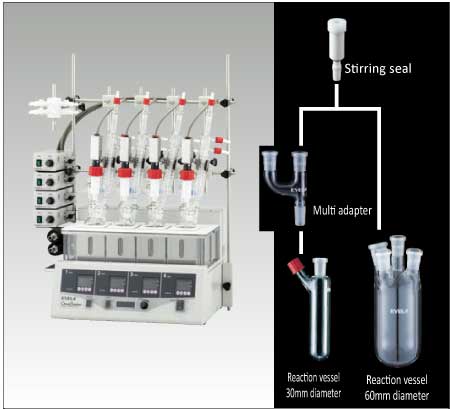
This system is designed for stirring viscous reaction solutions and reactions involving crystallization. It ensures reliable stirring with individual motors and does not require stirring bars, eliminating concerns about crushing crystals. It includes two types of vessels for 30mL and 150mL, allowing for different synthesis scale.
▶ For batch screening experiments of catalytic activity. 1.5 to 7mL x 6-unit
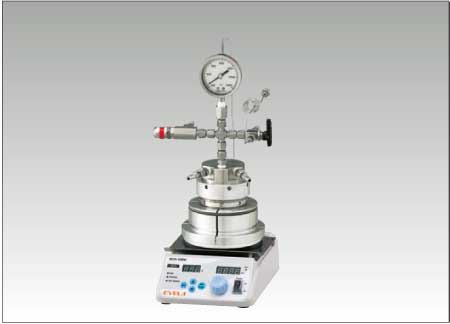
This system allows for the reaction of six samples under the same conditions, enabling rapid collection of multiple catalytic activity screening data. Individual reflux of solvent vapor can be achieved with cold fingers, preventing sample evaporation. It supports batch screening experiments of catalytic activity under pressurized conditions with reaction gases.
▶ Aluminum bath compatible with various vessel shapes
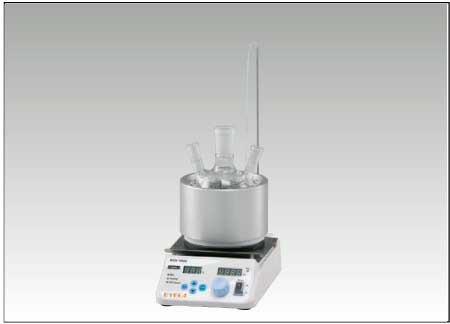
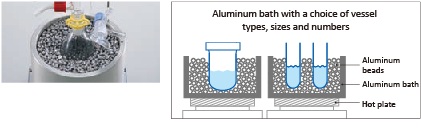
For the SynFlex system, which previously required aluminum blocks for each vessel size, an aluminum bath has been newly introduced. By adding aluminum beads to the aluminum bath, it is now possible to use a wide variety of vessels.
▶ Improves reaction yields and suppresses side reactions through microwave reaction fields
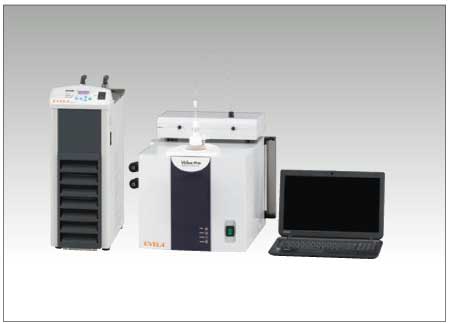
This microwave reactor is equipped with an aluminum block thermostatic chamber. It eliminates the effects of standing waves (hot areas) that existed in conventional microwave reactors, and realizes quantitative, high-speed heating by microwave absorption. At the same time, it can be used for low temperature synthesis of compounds by supporting constant temperatures from -13 to 200℃. It has highly accurate frequency and output characteristics, and both liquid temperature (internal temperature) and block temperature (external temperature) can be controlled (precise control of ±0.5℃), allowing verification experiments to be performed that separate the thermal and non-thermal effects of microwaves. It also has a microwave absorption measurement system (PAT), which contributes to the development of new reactions, catalysts, and new materials.
▶ For studying reaction conditions and optimizing processes at synthesis scales up to 250mL
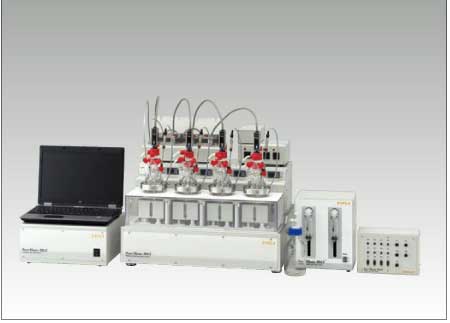
This parallel automated control system meets the requirements of both organic chemistry and process chemistry. The control software allows for experimental investigation of key process conditions during both process optimization and production stages. It provides high-precision control of individual reaction parameters (temperature, stirring and dosage rate) and supports heat flow measurement experiments.