Product line-up
HOME > Product line-up > Stirrers > What is a Stirrer? > What is a Stirrer?

TOKYO RIKAKIKAI CO., LTD.
HOME > Product line-up > Stirrers > What is a Stirrer? > What is a Stirrer?
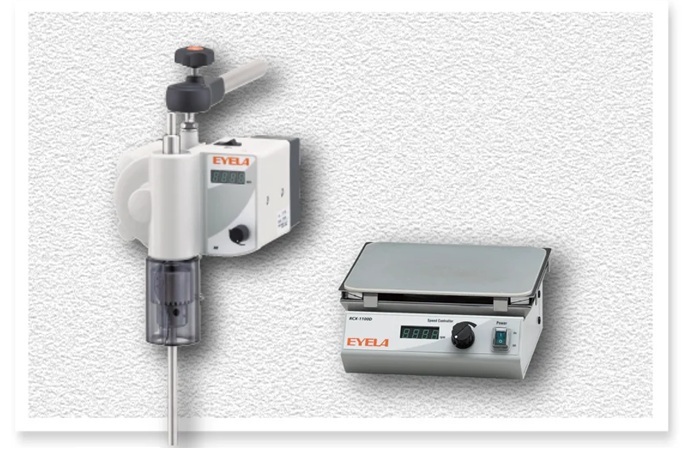
We offer a wide range of stirrers tailored to every application, from compact models for direct vessel mounting to high-torque explosion-proof units and R&D models with integrated torque meters.
Overhead stirrers with motor-driven shafts and impellers are designed for versatile stirring, covering everything up to high-viscosity samples. For low-viscosity liquids, closed containers, or small vessels, magnetic stirrers offer a seamless solution by synchronizing an internal magnet with a PTFE stirring bar.
EYELA provides a diverse range of magnetic stirrers, including heating-capable models and options for varying sample volumes. Choose the perfect model from our comprehensive lineup to match your research needs.
▶ Stirring states during forward and reverse rotation
▶ Magnetic Stirrer RCX Series: Introducing a high-power stirrer for powerful stirring
▶ Introducing direct-mounting stirrers: No shaft alignment required
▶Stirrers for stable stirring, even from a distance.
The standard solution is water, which has a viscosity of 1mPa·s. Use the table below as a guide to estimate the viscosity of your stirring sample.
| Substance name | Temperature (°C) | Viscosity (cP=mPa・s) |
| Acetone, Hexane | 20 | 0.322 |
| Ethyl acetate | 20 | 0.449 |
| Toluene | 20 | 0.586 |
| Benzene | 20 | 0.65 |
| Water | 20 | 1 |
| Nitrobenzene | 20 | 2 |
| Aniline | 20 | 4.4 |
| Kerosene | 20 | 10 |
| Concentrated lactic acid bacteria beverage | 24 | 31 |
| Vegetable oil | 23.5 | 65 |
| Tomato juice | 24 | 77 |
| Dynamo oil | 20 | 100 |
| Castor oil | 20 | 1000 |
| Substance name | Temperature (°C) | Viscosity (cP=mPa・s) |
| Honey | 21 | 1300 |
| Ketchup | 24 | 1800 |
| Condensed milk | 21.5 | 2000 |
| Strawberry jam | 23 | 6000 |
| Mayonnaise | 23 | 8000 |
| Shoe polish | 20 | 12000 |
| Cold cream | 23 | 18000 |
| Pressurized cylinder oil | 20 | 25000 |
| Toothpaste | 20.5 | 30000 |
| Chocolate topping | 21 | 38000 |
| Pomade | 21 | 45000 |
| Polymer | — | Up to 100000 |
| Sodium silicate Grade 1 | 20 | 240000 |
Note: To convert cP (centipoise) to cSt (centistokes), divide the cP value by the specific gravity.
To select the appropriate stirrer, you must choose a model with sufficient torque to agitate the liquid. The key factors and a summary of the calculation method are as follows.
Note: While the SI unit for torque is N·m, this explanation uses kg·cm for simplified calculation.
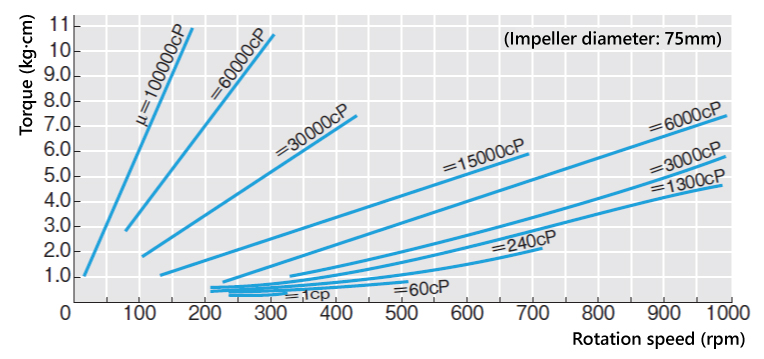
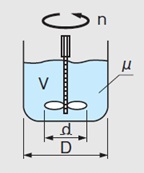
V: Volume (mL)
D: Vessel diameter (cm)
n: Rotation Speed (rpm)
μ: Viscosity (cP)
d: Impeller diameter (mm)
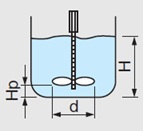
H: Liquid height (cm)
Hp: Height from vessel bottom to impeller (cm)
d: Impeller diameter (mm)
Required torque (X) = Load x d3 x n3 x μ) / (753 x n3 x μ)
Where:
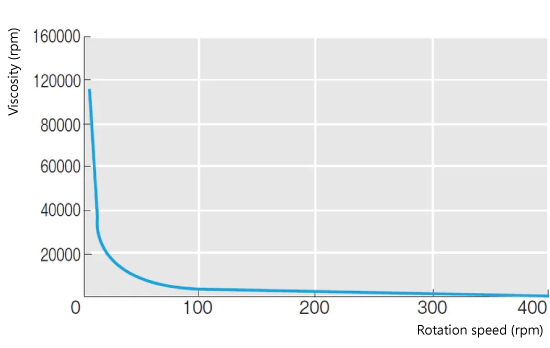
Load: Torque value derived from the viscosity (μ) graph.
75: Impeller diameter used in the reference graph.
The value obtained from this calculation should be multiplied by a safety factor of approximately 1.3, resulting in: X x 1.3 (kg · cm)
However, if the vessel has baffles or the liquid viscosity is 10cP or less, turbulent flow will occur when stirring with a 100 mm impeller. In such cases, the calculation must be adjusted by changing the power of 3 to 5.
Convert Torque to N · m: 1kg · cm = approx. 0.098N · m
This provides the required torque for your application.
Calculating & confirming liquid height (H):
H = V / (D / 2)2 x pi) = D x 0.44 to 1.2
Requirement: Ensure the value falls within this range.
Calculating & confirming (Hp):
Hp= H x 0.27 to 0.68
Requirement: Set the height within this range.
Calculating & confirming (d):
d = D x 0.33 to 0.70
Requirement: Set the height within this range.
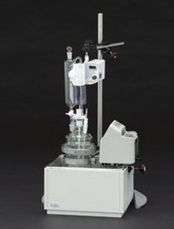
Case study: High-viscosity polymer stirring
Q: What are the target viscosity and volume for low-wattage stirring?
A: Viscosity is approximately 100,000cP with a volume of 1L.
Q: What are the vessel shape and dimensions?
A: Cylindrical; approx. 120mm diameter x 150mm depth.
Q: What is the intended rotation speed?
A: Approximately 100rpm.
Volume (V) = 1L = 1,000 mL
Vessel Diameter (D) = 120mm
Rotation Speed (n) = 100rpm
Viscosity (μ) = 100,000cP (Refer to graph)
Impeller Diameter (d): Set according to the vessel size. (Refer to Impeller diameter (d) below)
Liquid Height (H) = 1000 / ((12 / 2)2 x 3.14) = 8.8cm
Result: This value falls within the required range (12 x 0.44 to 1.2 = 5.28 to 14.4cm).
Height from vessel (Hp): 8.8 x 0.27 to 0.68 = 2.38 to 5.98cm
Impeller diameter (d): 120 x 0.33 to 0.70 = 39.6 to 84mm and set as 50mmL. When reading the graph, the load at 100rpm is 5.8 kg · cm.
Required torque: (5.8 x 503 x 1003 x 100,000) / (753 x 1003 x 100,000) = 1.72kg · cm
Considering a safety factor of approximately 1.3:
1.72 × 1.3 = 2.24 kg·cm
Converting this to SI units:
2.24 × 0.098 = 0.22 N·m
Based on this result, the models ZZ-1100, 1200, and 1300 series are suitable.
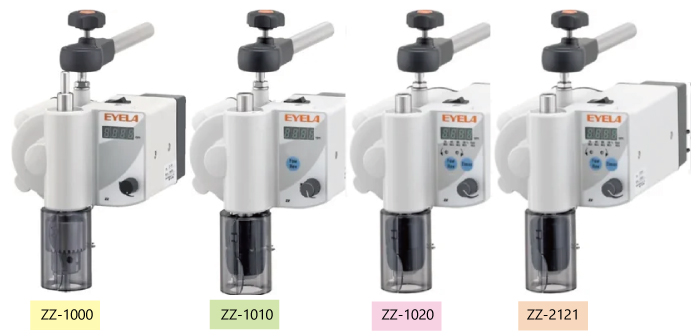
4 models are available to suit various applications
| Rotation speed range (rpm) | Max. torque (N · m) | Compatible models & specifications | |||||
| 50 to 3000 | 0.098 | ZZ-1000 ZZ-1000S | Motor output: 35 W, forward rotation, equipped with a drill chuck, (S type includes one stirring shaft and one marine impeller) | ZZ-1010 | Motor output: 35 W, equipped with a hand-tightened chuck collet, with reverse rotation function | ZZ-1020 | Motor output: 35 W, equipped with a hand-tightened chuck collet, featuring automatic reverse rotation, external input/output, and torque indication (5-level display). |
| 20 to 1200 | 0.245 | ZZ-1100 ZZ-1100S | ZZ-1110 | ZZ-1120 | |||
| 10 to 600 | 0.49 | ZZ-1200 ZZ-1200S | ZZ-1210 | ZZ-1220 | |||
| 5 to 300 | 0.98 | ZZ-1300 ZZ-1300S | ZZ-1310 | ZZ-1320 | |||
| 20 to 1200 | 0.392 | ZZ-2121 | Motor output: 80 W, equipped with a hand-tightened chuck collet, featuring automatic reverse rotation, external input/output, and torque indication (5-level display). | ||||
| 10 to 600 | 0.784 | ZZ-2221 | |||||
| 5 to 300 | 1.57 | ZZ-2321 | |||||
5-level display: in 20% increments relative to 100% of the maximum torque.
Selection should be made by considering the conditions such as viscosity, stir bar, vessel compatibility system, and liquid temperature.
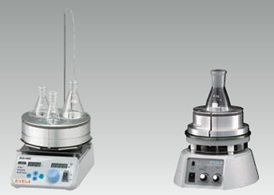
Left: Model RCH-1000
Control: Digital Setting, Speed Range: 50 to 1,500rpm, Temperature Range: Max. 310°C, Stirring Capacity: 20L (Water), Configuration: RCH-1000 + BBS-3HLD + Flask adapter
Right: Model RCH-3
Control: Analog (Dial) Setting, Speed Range: 50 to 1,500 rpm, Temperature Range: Max. 300°C, Stirring Capacity: 50mL to 3L (Water)
Configuration: RCH-3 + BBS-1HLD + Flask adapter
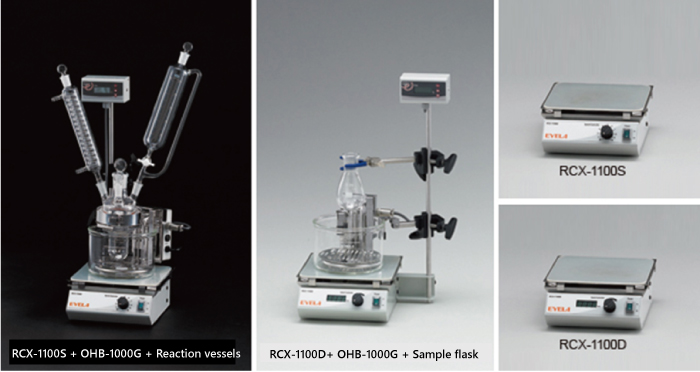
Model RCX-1100S
Control: Analog (Dial) Setting, Speed Range: 50 to 1,600rpm, Stirring Capacity: 10mL to 20L (Water)
Model RCX-1100D
Control: Digital Display, Speed Range: 50 to 1,600rpm, Stirring Capacity: 10mL to 20L (Water)
Please note that the following data is for reference only. Actual stirring performance may vary depending on the stirring bar selected. We recommend testing with your specific setup before full-scale use.
Test conditions
Standard viscosity liquids: JS2000, JS160,000 (250mL)
Sample Vessel: 50mL recovery flask (Pear shaped)
Stir Bar: 8mm diameter x 13mm (Octagonal)
Environment: Room temperature 20°C, 100V / 50Hz