Product line-up
HOME > Product line-up > Evaporators > What is a Rotary Evaporator? > What is a Rotary Evaporator?

TOKYO RIKAKIKAI CO., LTD.
HOME > Product line-up > Evaporators > What is a Rotary Evaporator? > What is a Rotary Evaporator?
Introduction: Rotary Evaporators
Rotary evaporators have become an indispensable tool in chemical, engineering, and biological research. They are among the most essential concentration devices used in laboratories and testing facilities for a wide range of applications, including concentration, fractional distillation, separation, and distillation.
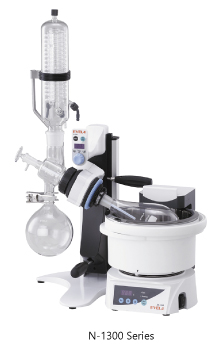
EYELA’s rotary evaporators are designed to significantly reduce concentration and distillation times while enabling high-precision fractionation and separation. Furthermore, our commitment to safety-driven design has earned us deep trust across countless research and manufacturing sites worldwide.
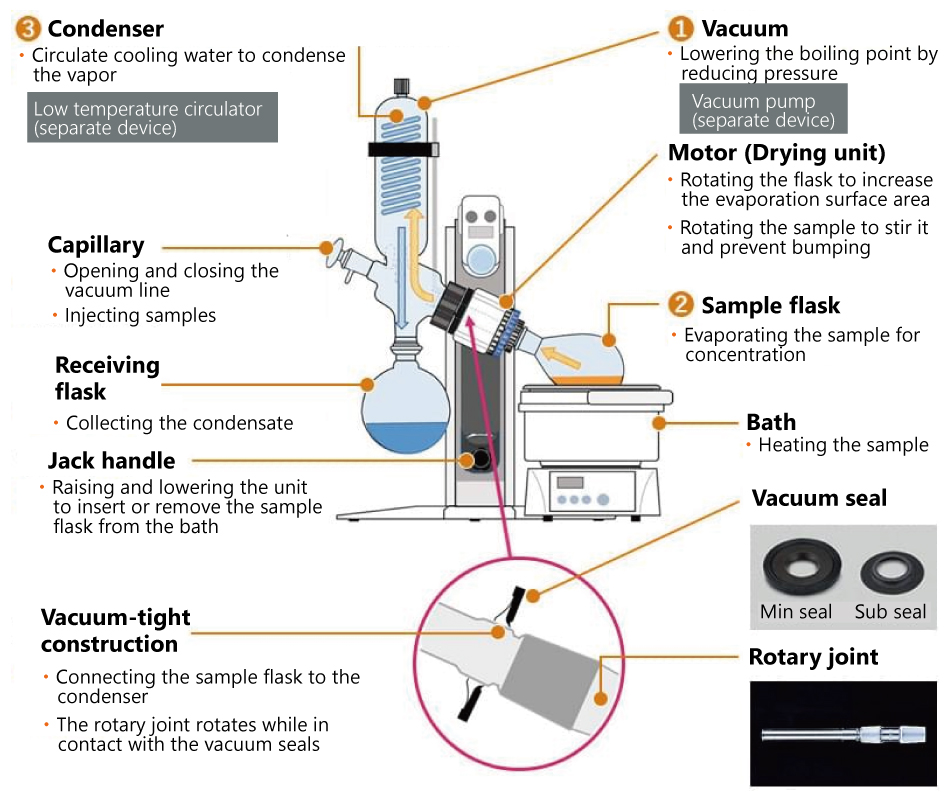

Reduces the pressure within the glass components to lower the boiling point of the solvent. For example, water boils at approximately 87°C at the summit of Mt. Fuji (3,776m, approx. 630hPa).

The liquid heated within the rotating sample flask flows into the condenser as vapor.

As cooling water flows through the condenser coils, the vapor is cooled, liquefied, and collected in the receiving flask.
Result:
The distillate is collected in the receiving flask, while the concentrated substance remains in the sample flask.
NOTE: Precise fractional distillation and separation of samples are possible by optimizing the operating conditions.
Concentration
To concentrate the components in a liquid
・Pre-treatment for analysis
・Removal of the extraction solvent
・Drying and dehydration of the sample
Fractionation / Separation
To separate volatile and non-volatile components
・Separation of mixed solvents
Distillation
To recover the condensed fraction based on the varying volatilities of the components
・Solvent purification
Q
Why Rotate the Sample Flask?
A
Rotating the flask creates a thin film of solution on the inner wall, increasing the surface area. Additionally, a film of warm water forms on the outside, enhancing heat transfer into the flask. The resulting agitation also prevents bumping (sudden boiling).

Q
Do vacuum seals and rotary joints wear out?
A
They gradually wear out and fail to maintain a vacuum, so periodic replacement is necessary. The vacuum seal wears out first, but its lifespan varies significantly depending on the samples used and the rotation speed. Therefore, regularly perform a vacuum check with an empty flask and a vacuum gauge to verify the ultimate pressure. While the rotary joint can be used for a long period, grooves will eventually form where it makes contact with the vacuum seal. Once these surfaces become uneven, it is time for replacement.
Q
Do you have any other questions?
A
Click here for Frequently Asked Questions (FAQ)
We can meet a wide range of needs by adding various accessories and options to the basic configuration.
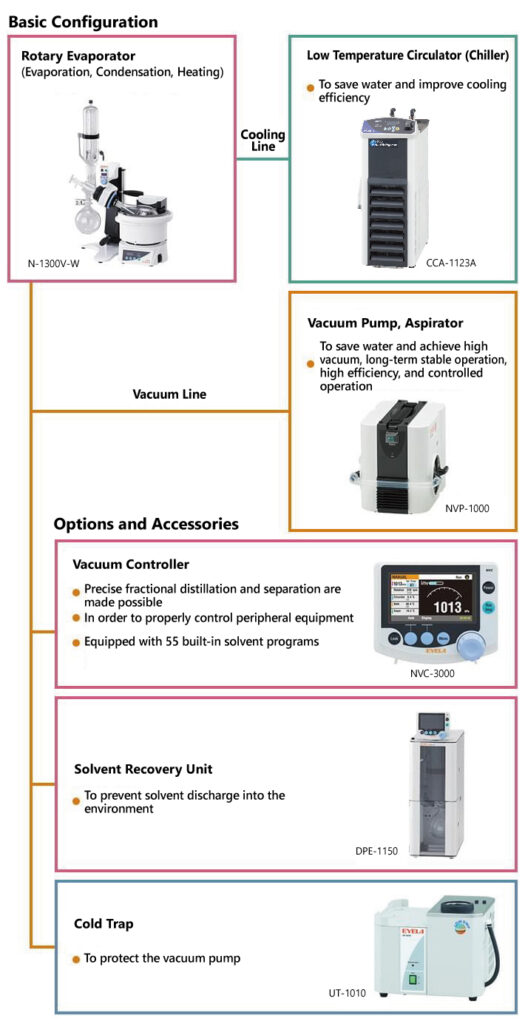
Click here for more details on each product
・Rotary Evaporators
・N-1300 Series Selection Guide
・Low Temperature Circulators (Chillers)
・Vacuum Pumps
・Vacuum Pump Controller
・Solvent Recovery Units
・Cold Traps
The following are just a few examples; our catalog introduces a wide range of system configurations tailored to various needs.
We also offer a variety of glass components with a special coating (EYELA COAT®) that minimizes the scattering of glass fragments in the event of breakage.
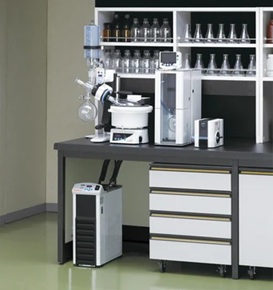
| Product name | Model | Cat. No. | QTY |
| Rotary evaporator | N-1300V-WS | 275340 | 1 |
| Low temperature circulator | CCA-1112A | 268450 | 1 |
| Diaphragm vacuum pump | NVP-1000 | 261800 | 1 |
| Solvent recovery unit | DPE-1150 | 271180 | 1 |
| NVC communication cord | COM-1M | 269460 | 3 |
| NVC communication cord | COM-2M | 269470 | 1 |
| Branch box for NVC communication | F-BOX | 269620 | 1 |
| Anti-condensation cover | — | 270740 | 1 |
| Cooling hose set 2m 9mm OD | — | 112700 | 3 |
| Vacuum hose 6 x 15mm | — | 119170 | 1 |
| Nybrine® 4kg | Z-1 | 263500 | 1 |
| Anti-condensation nozzle cover | — | 282130 | 1 |
| Total System Power Capacity 20.6A, 3 outlets required | |||
Click here for other standard concentration system examples.
Pre-use inspections and periodic maintenance of rotary evaporators are essential for maintaining performance and extending service life. Below are the specific inspection and maintenance methods.
Before use, inspect all glass components for any damage and ensure the EYELA Clip, which secures the sample flask to the rotary joint, is not cracked. Confirm that the water or oil level in the bath is appropriate, and that the vacuum and cooling water hoses are correctly connected and free of cracks. Check for any liquid leaks from the cooling water nozzle connections.
Wipe the glass components and other parts with a soft cloth, and apply a small amount of vacuum grease to the joints. (Consider the possibility of vacuum grease contamination.) After use, reapply vacuum grease to prevent seizing.
Turn on the power switch and press the RUN/STOP key to confirm that the rotation driving unit rotates smoothly from low to high speeds without any unusual noise or eccentricity. Ensure the jack lifts and lowers smoothly and that there is no interference. Just before starting the experiment, confirm that the rotating sample flask is properly immersed in the heating bath and that the bath fluid will not overflow due to thermal expansion of the liquid level.
After use, clean the surface of the equipment with a soft cloth to remove any remaining oil or solvent residue. Please clean the glass vessels in accordance with your facility’s glassware cleaning protocols.
Disconnect the joints, check for dirt, and wipe it away with a soft cloth before applying a small amount of vacuum grease. Periodically check for vacuum leaks while the rotor is rotating. If parts are seized, use heat-resistant gloves and a hot gun (a hairdryer can also be used) to warm the ground joints and melt the hardened solvent or grease to facilitate removal.
Take care to keep moisture away from electrical components; in particular, moisture at wiring junctions is strictly prohibited. Since cooling water piping is prone to condensation, ensure there is sufficient distance between the piping and the electrical wiring.
Please use genuine parts. Mixing and using components from other manufacturers may cause fatal damage to the equipment.
Please ensure that you perform periodic inspections on a regular basis.
Rotary evaporators are devices used for the efficient evaporation, separation, and concentration of solvents in chemical experiments, but several precautions are necessary to ensure safety. The use of personal protective equipment (PPE) is fundamental, and the use of safety glasses is specifically recommended. Furthermore, due to the risks of burns or implosions, it is important to manage the temperatures of the cooling water and the bath, control the vacuum levels, and avoid contact with the rotating sample flask. Additionally, attention must be paid to the volatility of hazardous solvents, and proper ventilation is required.
Safety regarding rotary evaporators is critically important in laboratory work. The following details the key elements related to rotary evaporator safety.
When operating the equipment, it is recommended to wear safety glasses or goggles, a lab coat or apron, chemical-resistant gloves, and closed-toe shoes. These measures protect the body from chemical splashes and vapors.
To reduce the risk of inhaling volatile solvent vapors, it is essential to use an exhaust hood to capture and discharge harmful vapors. In addition to ensuring overall laboratory ventilation, it is highly recommended to install the equipment inside a fume hood.
Periodically inspect the condition of glassware and seals, checking for any cracks or wear. Promptly replace damaged parts and maintain the vacuum pump to prevent equipment failure.
Confirm that all components are functioning normally at startup, and monitor the temperature and level of the water or oil in the bath. Adjust the pressure gradually to prevent sudden evaporation caused by rapid pressure changes (use vacuum controllers, trap bulbs, or bumping prevention device (safety cap).
Conduct regular safety training to ensure that employees are familiar with emergency response procedures. It is also important to place emergency equipment, such as fire extinguishers and spill kits, in readily accessible locations.
Adhering to these guidelines enables the safe use of rotary evaporators and significantly reduces the risk of accidents in the laboratory.