Product line-up
HOME > Product line-up > Ovens > What is an Oven? > What is an Oven?

TOKYO RIKAKIKAI CO., LTD.
HOME > Product line-up > Ovens > What is an Oven? > What is an Oven?
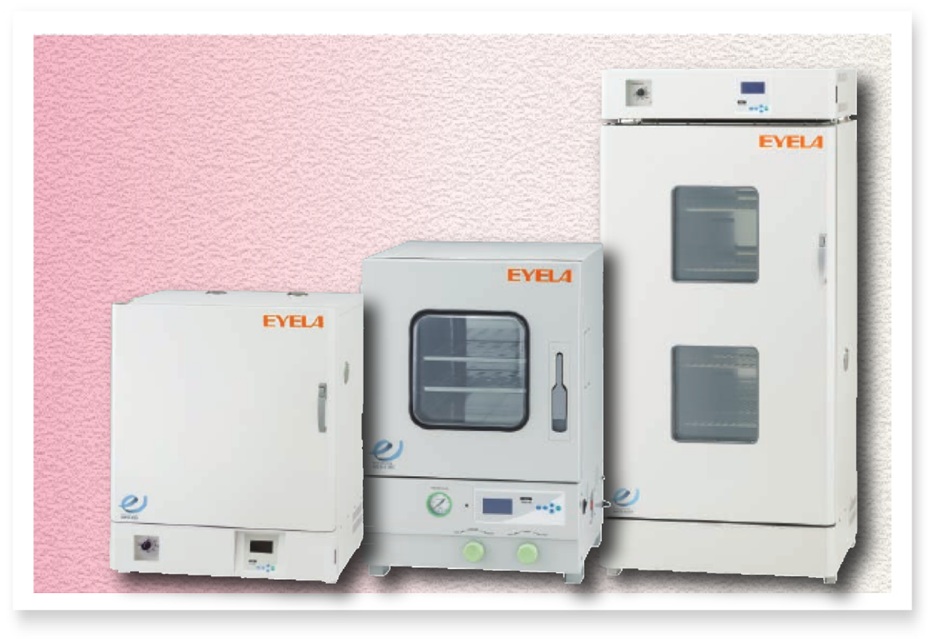
Ovens can be broadly classified into the following four types.
| Types | Convection/Heating methods | ||
| 1. Natural convection oven | Natural convection | ||
| 2. Forced air flow oven | Forced air flow | ||
| 3. Drying oven | Natural convection | Dehumidification and drying | — |
| 4. Vacuum drying oven | Vacuum + chamber heating | Vacuum + chamber heating + heated shelf | Vacuum + hot plate |
Since the heat from the heater creates gentle convection within the chamber, it is suitable for drying samples such as powders and granules that should not be scattered.
<Example: NDO-420 / NDO-520 Series>
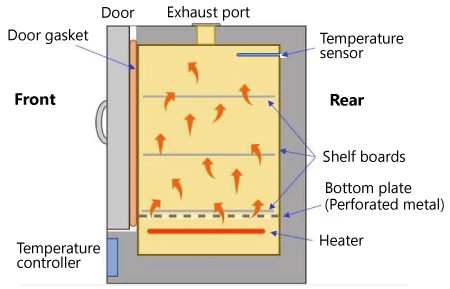
The heater is installed beneath the bottom plate. It generates heat regulated according to the set temperature. The heated air rises and circulates through the perforated metal (punching holes) in the bottom plate, warming the entire chamber. A temperature sensor mounted at the top of the chamber measures the internal temperature and provides feedback to the temperature controller.
The internal fan forcibly circulates air throughout the chamber, resulting in less temperature fluctuation compared to natural convection models and significantly reducing drying time.
<Example: WFO-420 / NDO-520 Series>
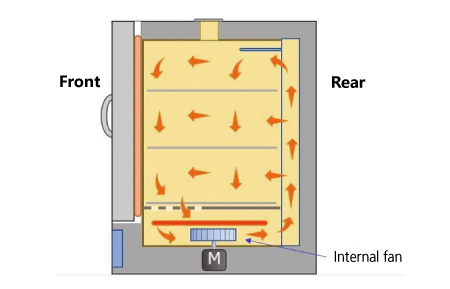
The basic structure is the same as that of natural convection ovens. A fan is installed at the heater section to create forced air convection. Air is circulated not only from top to bottom but also horizontally from the rear, which minimizes temperature fluctuations.
Natural convection method that performs drying at relatively low temperatures of 80°C or below.
<Example: AWO-1001>
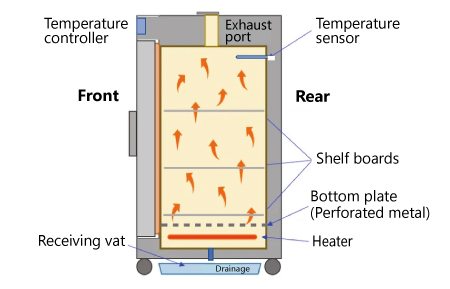
The basic structure is identical to that of natural convection ovens. Heated air rises and circulates through the perforated plate (Punching holes) in the bottom plate to warm the entire chamber. Any water droplets are collected in the receiving vat (water tray) located at the bottom.
A dehumidifying drying method that does not use a heater, gently drying equipment.
<Example: LWO Series>
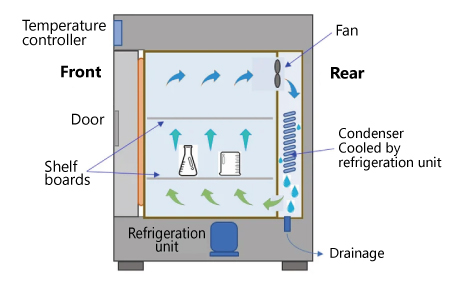
Dehumidification and drying are performed by a refrigeration unit without the use of a heater. Moisture from the equipment is cooled and condensed by the “condenser” at the rear, then drained through the drain on the side of the unit. Dry air is blown out from the bottom of the chamber to accelerate the drying of the equipment. This allows for the drying of heat-sensitive equipment and samples.
Drying under vacuum or in an inert gas atmosphere.
Suitable for samples that are difficult to dry with conventional ovens or are sensitive to oxidation.
<Example: VOS-210C · 310C / VOS-452SD · 602SD>
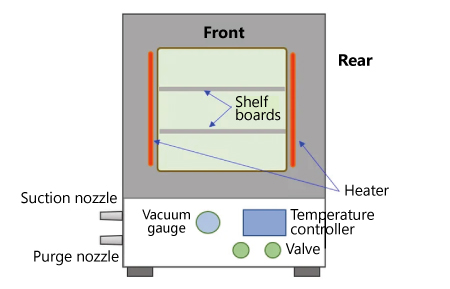
Drying under vacuum or in a gas atmosphere. Heaters are installed within the chamber walls on both sides. Samples are heated through radiation from the inner walls and thermal conduction from the shelf boards.
<Example: PVO-450>
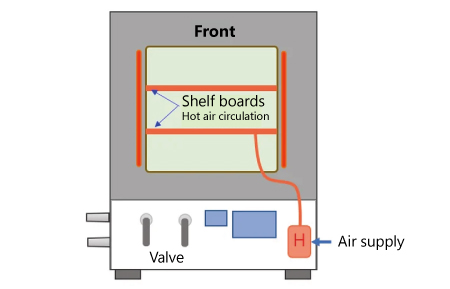
A unique shelf-heating system utilizing shelves. The shelves are heated by warm air without the use of heaters or oil, allowing easy removal of shelf boards and eliminating concerns such as overheating or liquid leakage.
<Example: VOM-1000A · A1 · B>
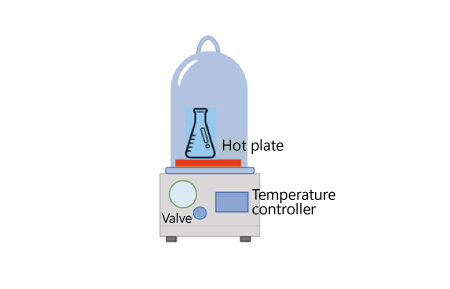
Drying under vacuum or in a gas atmosphere. Designed for micro-samples, it uses a hot plate for heating. The chamber is made of glass, allowing for easy observation of the samples.
| Purpose | Content | Operating temperature | Ovens used |
| Sample Drying | Moisture removal and drying of grains, vegetables, and food products. Drying of wood (timber), minerals, and soil samples. | 35 to 200℃ | Natural convection oven, Forced air flow oven, Vacuum drying oven, Drying oven |
| Utensils Drying (Med to High Temp.) | Drying of glassware, tweezers, and other metallic instruments. | 50 to 105℃ | Drying oven, Natural convection oven, Forced air flow oven |
| Utensils Drying (Low Temp.) | Drying of heat-sensitive equipment, such as graduated glassware, measuring instruments, and plastic (resin) labware. | 25 to 35℃ | Drying oven |
| Constant Temperature / Heat Resistance Testing | Constant temperature testing of materials, parts, and molded products. Temperature testing of heat-resistant materials. | 30 to 500℃ | Natural convection oven, Forced air flow oven, Vacuum drying oven |
| Moisture Measurement | Moisture removal for the measurement of moisture content and water volume. | 100 to 150℃ | Natural convection oven |
| Pre-treatment for Inspection | Moisture removal and pre-treatment for food hygiene inspections. | 70 to 105℃ | Natural convection oven |
| Degassing / Deaeration | Removal of dissolved gases and degassing (deaeration) under vacuum. Removal of microbubbles. Removal of oxygen (deoxygenation). | 40 to 200℃ | Vacuum drying oven |
| Solvent Removal | Removal of solvents, acids, alkalis, and other substances. | 40 to 200℃ | Vacuum drying oven |
| Thermosetting / Molding | Resin molding and annealing. Thermal curing of adhesives. Vacuum heat treatment. | 70 to 180℃ | Natural convection oven, Forced air flow oven, Vacuum drying oven |
| Painting / Plating | Drying and baking of paint films (coatings). Baking treatment. | 40 to 220℃ | Natural convection oven, Forced air flow oven |
Given that these units are frequently operated at high temperatures, they are equipped with a range of safety features.
An alarm is displayed and control is stopped (Heater OFF, Circulation Fan OFF) when the door is open or ajar. (In Models NDO and WFO series, a buzzer sounds if the door remains open for one minute.) This prevents abnormal overheating of samples caused by continuous heating while the door is left open. In Model WFO model, the fan stops to prevent the blast of hot air from escaping.
An alarm is displayed if a temperature sensor disconnection (open circuit), short circuit, or heater burnout occurs.
An alarm is displayed if the temperature exceeds the set upper or lower limits. Depending on the model, two-stage settings are available, and there are two types of responses: continued control or controlled shutdown, depending on the specific alarm type.
The power is forcibly shut OFF if the internal temperature rises above the temperature set on the “Overheat Protector.” The setting of the overheat protector is adjustable and should be set 20 to 30°C higher than the target internal temperature.
The breaker trips and cuts OFF the power if a ground fault (leakage) occurs or if an overcurrent flows through the circuit.
The smaller the temperature variance within the chamber, the more uniform the temperature control. This variance is referred to as “Temperature Distribution Accuracy.”
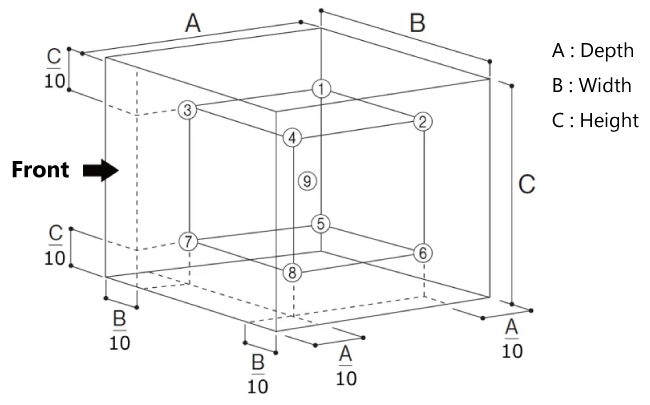
| ● Spatial Temperature Variation | The difference between the “average value at the chamber center” and the “average value of the point with the greatest temperature difference” among the other 8 points. |
| ● Temperature Ramp | The difference between the “maximum value of average temperatures” and the “minimum value of average temperatures” among all 9 points. |
| For example, Model NDO-420 is specified with a spatial temperature variation of 11°C and a temperature ramp of 16°C. | |
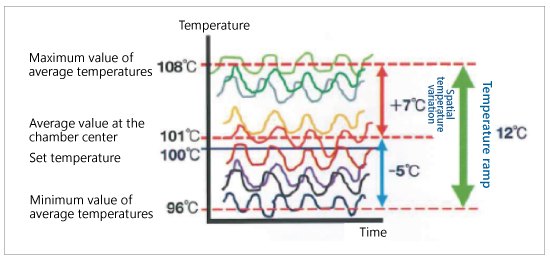
In the case above, with a set temperature of 100°C, the chamber center is 101°C, the maximum point is 108°C, and the minimum point is 96°C. Consequently, the spatial temperature variation is 7°C, and the temperature gradient is 12°C.
(Note: Both are calculated using the average values of each point.)
| ● Timer and Program Functions | In addition to Fixed-value Operation, which maintains a constant temperature, these ovens are equipped with timer and program functions. |
| ● Temperature Compensation Function | This function aligns the controller’s displayed temperature with the actual temperature at the specific location where the sample is placed. It enables reliable temperature control in closer proximity to the sample. The difference between the temperature measured by a standard reference thermometer and the temperature displayed on the operation panel is entered as a correction value. |
| ● Auto-tuning Function | The temperature is controlled using PID control. While the PID parameters are pre-set at the factory, the optimal combination may vary depending on conditions such as the operating temperature range, load, and ambient room temperature. Auto-tuning is a function that derives the optimal PID parameters from the actual temperature waveforms during operation. Under normal circumstances, the factory-set PID parameters are sufficient; however, if control instability or fluctuations occur, auto-tuning should be performed. |
| ● Communication and Recorder Output Functions | Some models can be equipped with an RS-232C interface for remote operation and PC-based temperature monitoring/recording, a USB port for data export to a flash drive, or output terminals for an external recorder (all available as factory-installed options). |
| ● Graphical Display Function | Timer and program setting screens are displayed graphically, allowing for more intuitive visual confirmation and configuration. |
There are two main types of shelve boards used in the ovens.
| 1. Perforated Metal Type (Punching holes) | 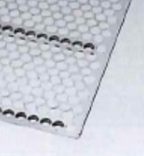 | A type featuring numerous round punched holes in a stainless steel (SUS) plate. Convenient for holding items with narrow bases, such as test tube racks, or slender vessels. Compared to the wire type, it may slightly restrict airflow. |
| 2. Wire Type | 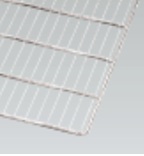 | This type consists of stainless steel (SUS) wires assembled in a grid pattern and welded together. It offers minimal resistance to airflow, making it advantageous for reducing temperature variance. However, slender instruments or test tube racks with thin bases tend to be unstable on this surface. |
| VOS-602SD with Model HSS Base Stand | 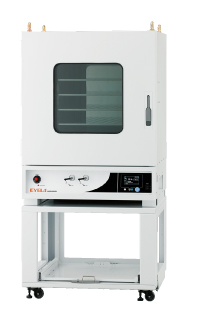 |
| Model HSD Stacking Stand for NDO and WFO Series | Two ovens can be stacked for space-saving use. This unit includes a cooling fan to dissipate heat from the lower unit. | |
| Shelf boards (Model HST) and Shelf Board Support Bracket (Model HSH) |
| Model EU-300 for NDO · WFO-420(W) · 520(W) | Installed on the top panel of the oven, this unit collects gases leaking from the exhaust port and uses an exhaust fan to vent them through an aluminum duct to a fume hood or similar ventilation system. | |
| Used for reducing pressure in vacuum ovens. |
| Models UT and ECC Series | Installed between the vacuum oven and the vacuum pump to cool and collect moisture and solvents. | |